Showing posts with label photos. Show all posts

Sunday, March 2, 2008

While educators are aware that they have great responsiblity to teach content and skills to learners of all ages, we are mostly unaware that we are providing reflections of ourselves to 'the machine' each time we use the World Wide Web'.

I first happened upon the phrase "Teaching the Machine" in Michael Wesch's Video: Web 2.0... The Machine is Us/ing Us. Just past the half way mark of the video, an article that I'd read many months earlier, is referenced. The Web version of "We are the Web", first published in Wired Magazine in August 2005, remains timely in helping us understanding our role in 'wiring' the neural networks of the World Wide Web:

"...And who will write the software that makes this contraption useful and productive? We will. In fact, we’re already doing it, each of us, every day. When we post and then tag pictures on the community photo album Flickr, we are teaching the Machine to give names to images. The thickening links between caption and picture form a neural net that can learn."

It was earlier this afternoon that I experienced how quickly the machine can learn. In uploading a batch of outdoor auto show photos I'd taken two years ago, I taught the machine by adding appropriate filenames and tags to each of the images. Although time has yet to provide me the liberty to provide more descriptive detail, by zooming in and clicking on a global map, I was also able to plot the location where I'd taken these photographs.

What I didn't realize, is that I also taught the machine by providing metadata that was included in the image files themselves. Flickr now knows the camera I used, and the dates/times the photos were taken. The once amazing ideas shared almost a year ago in the Photosynth Talk at TED, suddenly seem all the more real and personal to me:


Teaching the machine about images, is only part of the role we all play in teaching the machine. In the next few days, I'll be trying a focused thought experiment to consider what we teach it when:

1] we link to ideas;
2] we define words and ideas in Wikipedia;
3] we refine searches in 'Google'; and by following the 'right' link, provide feedback to the machine;
4] we play, then win or lose at games like chess or Texas Hold 'em;
5] we make online purchases;
6] we send and receive text messages, tweets, and email to members of our networks...

When the morning arrives, I'll begin expanding on these ideas via the Teacher 2.0 Podcast.

Teaching the Machine: Part I

While educators are aware that they have great responsiblity to teach content and skills to learners of all ages, we are mostly unaware that we are providing reflections of ourselves to 'the machine' each time we use the World Wide Web'.

I first happened upon the phrase "Teaching the Machine" in Michael Wesch's Video: Web 2.0... The Machine is Us/ing Us. Just past the half way mark of the video, an article that I'd read many months earlier, is referenced. The Web version of "We are the Web", first published in Wired Magazine in August 2005, remains timely in helping us understanding our role in 'wiring' the neural networks of the World Wide Web:

"...And who will write the software that makes this contraption useful and productive? We will. In fact, we’re already doing it, each of us, every day. When we post and then tag pictures on the community photo album Flickr, we are teaching the Machine to give names to images. The thickening links between caption and picture form a neural net that can learn."

It was earlier this afternoon that I experienced how quickly the machine can learn. In uploading a batch of outdoor auto show photos I'd taken two years ago, I taught the machine by adding appropriate filenames and tags to each of the images. Although time has yet to provide me the liberty to provide more descriptive detail, by zooming in and clicking on a global map, I was also able to plot the location where I'd taken these photographs.

What I didn't realize, is that I also taught the machine by providing metadata that was included in the image files themselves. Flickr now knows the camera I used, and the dates/times the photos were taken. The once amazing ideas shared almost a year ago in the Photosynth Talk at TED, suddenly seem all the more real and personal to me:


Teaching the machine about images, is only part of the role we all play in teaching the machine. In the next few days, I'll be trying a focused thought experiment to consider what we teach it when:

1] we link to ideas;
2] we define words and ideas in Wikipedia;
3] we refine searches in 'Google'; and by following the 'right' link, provide feedback to the machine;
4] we play, then win or lose at games like chess or Texas Hold 'em;
5] we make online purchases;
6] we send and receive text messages, tweets, and email to members of our networks...

When the morning arrives, I'll begin expanding on these ideas via the Teacher 2.0 Podcast.

Monday, February 11, 2008

I've been looking for a reason to share some ideas about the use of online photos in the classroom and although there are indeed educators making use of photography in their classrooms, few of them leverage the best of the free image resources of the day.

Why not help those creative writers by providing inspirational 'characters' to write about? Consider projecting some of these amazing 365 Portraits for starters.

Invite participation to categorize, sort and add meaning to once forgotten images in the Library of Congress Pilot Project.

Why not create a library of welcoming 'school/community guidebook' photos for families new to the community. Students can add explanatory audio notes via VoiceThread. Maybe you can even put those cell-phone cameras to use?

Highlight the power of photos when combined with words and music... easily worth more than 1000 Words.

How about teaching students to take advantage of terrific free public photos rather than ignoring fair use by grabbing the work of others that just happens to reside on the web. Free Digital Photos or BigFoto.com or FreeFoto.com are good starting points, but there are many others.

Consider teaching students that they can actually license their photos (and other creative works) for various uses vie Creative Commons licensing? For a generous example, some put their photos into the public domain a la Robert Scoble

Don't we owe it to students to point out how their world will be very different from ours? Showcase Photosynth in the video below, and ask students to contemplate the consequences: Are students being prepared for this future... for the jobs in such a world... for the yet-unwritten rules of the coming decades? Is it exciting, scary or both?


Review the dilemmas posed by those who 'sanitize' or 'satanize' with photo editing... Consider photo-ethics by consider sharing any of a number of Photo-Ethics resources.

Teach about Photo-editing via site resources like Luxa or teach the use of an online editor like Splashup. No doubt you'll want to share the often linked Dove commercial to expose some advertising secrets:


For those who may be interested, I maintain many more terrific links on my Delicious pages.

Stuck on Photos

I've been looking for a reason to share some ideas about the use of online photos in the classroom and although there are indeed educators making use of photography in their classrooms, few of them leverage the best of the free image resources of the day.

Why not help those creative writers by providing inspirational 'characters' to write about? Consider projecting some of these amazing 365 Portraits for starters.

Invite participation to categorize, sort and add meaning to once forgotten images in the Library of Congress Pilot Project.

Why not create a library of welcoming 'school/community guidebook' photos for families new to the community. Students can add explanatory audio notes via VoiceThread. Maybe you can even put those cell-phone cameras to use?

Highlight the power of photos when combined with words and music... easily worth more than 1000 Words.

How about teaching students to take advantage of terrific free public photos rather than ignoring fair use by grabbing the work of others that just happens to reside on the web. Free Digital Photos or BigFoto.com or FreeFoto.com are good starting points, but there are many others.

Consider teaching students that they can actually license their photos (and other creative works) for various uses vie Creative Commons licensing? For a generous example, some put their photos into the public domain a la Robert Scoble

Don't we owe it to students to point out how their world will be very different from ours? Showcase Photosynth in the video below, and ask students to contemplate the consequences: Are students being prepared for this future... for the jobs in such a world... for the yet-unwritten rules of the coming decades? Is it exciting, scary or both?


Review the dilemmas posed by those who 'sanitize' or 'satanize' with photo editing... Consider photo-ethics by consider sharing any of a number of Photo-Ethics resources.

Teach about Photo-editing via site resources like Luxa or teach the use of an online editor like Splashup. No doubt you'll want to share the often linked Dove commercial to expose some advertising secrets:


For those who may be interested, I maintain many more terrific links on my Delicious pages.

Saturday, December 22, 2007


The Google Blog has just posted a radical idea for bringing the world together in a compelling way over the next week or so. My Maps are Our Maps invites people to post stories, traditions and more in the form of photographs embedded into a Google Map. (Photos, or YouTube videos can be embedded; but content must be present on the World Wide Web prior to adding it to a Google map.)

The entry includes a link to a Google Map user guide. It will be very interesting to see how this map develops as the personal stories of global celebrations of Christmas, Chanukah and the New Year are added. This is one terrific example of Digital Storytelling!

If only educators had known about this before the end of school for the holiday break...? Certainly there are other classroom and community applications for such a project. It is an engaging idea that can be scaled from classroom, to school, to community, to city, to state/province, to country, to the global community. I'm guessing we'll soon see more than few educational adaptations of this idea... A few of my own ideas are on today's Teacher 2.0 Podcast.

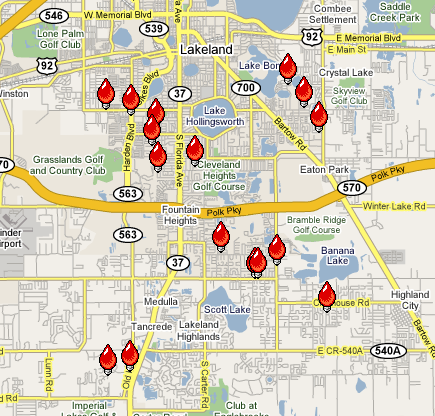
Found one! A local holiday Christmas lights map! This map highlights outstanding light displays in Lakeland Florida, spring home of the Detroit Tigers:

Google Holiday Map


The Google Blog has just posted a radical idea for bringing the world together in a compelling way over the next week or so. My Maps are Our Maps invites people to post stories, traditions and more in the form of photographs embedded into a Google Map. (Photos, or YouTube videos can be embedded; but content must be present on the World Wide Web prior to adding it to a Google map.)

The entry includes a link to a Google Map user guide. It will be very interesting to see how this map develops as the personal stories of global celebrations of Christmas, Chanukah and the New Year are added. This is one terrific example of Digital Storytelling!

If only educators had known about this before the end of school for the holiday break...? Certainly there are other classroom and community applications for such a project. It is an engaging idea that can be scaled from classroom, to school, to community, to city, to state/province, to country, to the global community. I'm guessing we'll soon see more than few educational adaptations of this idea... A few of my own ideas are on today's Teacher 2.0 Podcast.

Found one! A local holiday Christmas lights map! This map highlights outstanding light displays in Lakeland Florida, spring home of the Detroit Tigers: