Showing posts with label school. Show all posts

Tuesday, April 21, 2009

Seth Godin recently reposted "This is Broken", a talk from a few years ago, that has me wondering why we don't do more about fixing an education system that so many of us realize is broken...


What's broken in school?

Why do high schools begin classes before teens are awake?
Why do we rely on written tests for students to demonstrate their learning?
Why do students have to sit in such uncomfortable chairs?
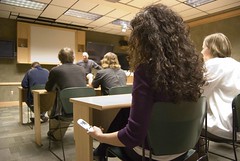
Why do we prevent useful technologies like cell phones from entering the classroom?
Why do 5 year olds have to carry backpacks to school?
Why does chalk still exist in classrooms?
Why does so much 'learning' take place with students sitting down and listening?
Why do the best teachers often feel like they have to teach with their doors closed?


What broken things would you like to add to the list?
How can we being to fix some of these broken things?

What Else is Broken?

Seth Godin recently reposted "This is Broken", a talk from a few years ago, that has me wondering why we don't do more about fixing an education system that so many of us realize is broken...


What's broken in school?

Why do high schools begin classes before teens are awake?
Why do we rely on written tests for students to demonstrate their learning?
Why do students have to sit in such uncomfortable chairs?
Why do we prevent useful technologies like cell phones from entering the classroom?
Why do 5 year olds have to carry backpacks to school?
Why does chalk still exist in classrooms?
Why does so much 'learning' take place with students sitting down and listening?
Why do the best teachers often feel like they have to teach with their doors closed?


What broken things would you like to add to the list?
How can we being to fix some of these broken things?

Thursday, October 23, 2008

Earlier this week, I had a rare opportunity to have lunch with my identical twin brother. Even though we've taken different paths in our lives, we've each managed to make use of the tools of the evolving web in order to connect with colleagues.

With this common interest, it's no surprise that our conversation consistently returns to the use of the Internet, and a wide range of teaching and learning applications. While waiting for our meals to arrive at our table, I suggested that traditional tests might be rendered useful, if we were to teach students how to cheat in completing them.

While it may sound radical to encourage cheating, students today have grown up in a culture that generally accepts a variety of unsavoury behaviours:
* finding and sharing 'cheat' codes for video games;
* bypassing digital rights management on CD and DVD media;
* using proxy servers to access filtered/blocked/banned web content;
* downloading applications from the web and using 'cracks' to gain access;
* accessing private networks, whether open or password protected;
* cracking digital devices to expand their functionality beyond licensing agreements;
* creating unique works by appropriating the unlicensed photographic or musical expertise of others;

It's no secret that I am on unfriendly terms with the traditional test, so if I had to give students a test today, I think I'd challenge them to respond with limited restrictions. I might allow them to talk to one another; to copy from one another; or to access the internet or outside experts.

What skills might students develop in sanctioned cheating?


In a group or class test:
In copying content from other students, each learner would have to apply critical thinking skills in validating responses. If a class or group had to submit one complete test for the entire group, you'd really be able to assess the collaborative skills possessed by a group or sub-groups. Without a doubt, an observant teacher would be able to see which students had the greatest sharable 'capital', and which had the most effective leadership skills.

In an open book test:
Students would have to condense material into it's most important elements, and would have to organize their resources so that appropriate content could be efficiently accessed.

In a test to design a cheating tool:
Students would highlight their varied abilities to innovate in creating unique uses for personal digital devices; or they might demonstrate their creativity in re-purposing common backpack or lunchbox objects.

In an open computer test:
Beyond exhibiting their search skills, students would be challenged to assess the validity of their sources. Another important skill might be embedded in this activity, were a teacher to require students to provide more than one reference for any test response.

In an open phone test:

Students might have to budget a limited number of text messages or phone-a-friend calls, meaning they'd have to assess their areas of greatest need. Could metacognition skills actually be testable?!

Here's your test question... Use any source you like, but in posting your response below, reference your source(s), and try to provide a level of confidence in your answer.

"How many different times have human beings been to the moon?"

C'mon, you can answer that one can't you? Go ahead and cheat if you like!


Photo Credit: Mr. Stein; Billaday

Let's Teach Them to Cheat!

Earlier this week, I had a rare opportunity to have lunch with my identical twin brother. Even though we've taken different paths in our lives, we've each managed to make use of the tools of the evolving web in order to connect with colleagues.

With this common interest, it's no surprise that our conversation consistently returns to the use of the Internet, and a wide range of teaching and learning applications. While waiting for our meals to arrive at our table, I suggested that traditional tests might be rendered useful, if we were to teach students how to cheat in completing them.

While it may sound radical to encourage cheating, students today have grown up in a culture that generally accepts a variety of unsavoury behaviours:
* finding and sharing 'cheat' codes for video games;
* bypassing digital rights management on CD and DVD media;
* using proxy servers to access filtered/blocked/banned web content;
* downloading applications from the web and using 'cracks' to gain access;
* accessing private networks, whether open or password protected;
* cracking digital devices to expand their functionality beyond licensing agreements;
* creating unique works by appropriating the unlicensed photographic or musical expertise of others;

It's no secret that I am on unfriendly terms with the traditional test, so if I had to give students a test today, I think I'd challenge them to respond with limited restrictions. I might allow them to talk to one another; to copy from one another; or to access the internet or outside experts.

What skills might students develop in sanctioned cheating?


In a group or class test:
In copying content from other students, each learner would have to apply critical thinking skills in validating responses. If a class or group had to submit one complete test for the entire group, you'd really be able to assess the collaborative skills possessed by a group or sub-groups. Without a doubt, an observant teacher would be able to see which students had the greatest sharable 'capital', and which had the most effective leadership skills.

In an open book test:
Students would have to condense material into it's most important elements, and would have to organize their resources so that appropriate content could be efficiently accessed.

In a test to design a cheating tool:
Students would highlight their varied abilities to innovate in creating unique uses for personal digital devices; or they might demonstrate their creativity in re-purposing common backpack or lunchbox objects.

In an open computer test:
Beyond exhibiting their search skills, students would be challenged to assess the validity of their sources. Another important skill might be embedded in this activity, were a teacher to require students to provide more than one reference for any test response.

In an open phone test:

Students might have to budget a limited number of text messages or phone-a-friend calls, meaning they'd have to assess their areas of greatest need. Could metacognition skills actually be testable?!

Here's your test question... Use any source you like, but in posting your response below, reference your source(s), and try to provide a level of confidence in your answer.

"How many different times have human beings been to the moon?"

C'mon, you can answer that one can't you? Go ahead and cheat if you like!


Photo Credit: Mr. Stein; Billaday

Sunday, October 5, 2008

Last week, I had the chance to join a few e-learning colleagues for a tour of Pelee Island School in support of teachers and students who are piloting an e-learning project. Even while technology is being used to address unique educational challenges, our trip was in many ways, like stepping back in time...

Get your bearings... Pancake flat in the middle of Lake Erie, Pelee Island is the southernmost land mass in Canada.


The island is populated almost exclusively along the coastline, with the Pelee Island Winery, bed and breakfast accommodations, estate homes and more, readily accessible by automobile or bicycle.


The MV Jiimaan is one of two ways to get to the island in good weather. Once winter weather sets in (November-April?), you'll need to book a flight to reach this jewel. With room for up to 40 vehicles and 400 passengers, you'd be wise to have a reservation.


Calm weather meant our 8 a.m. departure and 4 p.m. return could run right on schedule, with each trip taking 90 minutes to/from the Leamington dock.


You can't make this stuff up! Our hosts kindly left their vehicle waiting at port for us to drive out to the school. The Rolling Rock sign in the front windshield of our loaner van, boasted ""Same as it ever was...". You can imagine our response when the first lines we heard on the radio were: "Same as it ever was... Same as it ever was... Same as it ever was..." from "Once in a Lifetime" by the Talking Heads. We thought, nice, they left us a CD or audio tape... but no, it was playing on the radio!


Heading north from the ferry dock towards the school, we learned to return the waves of oncoming drivers before being greeted by the "shoe tree". Clearly we were in a different place!

The three room school house sits beside the now closed Pelee Island high school, and at the time of this photo, a rope in the entrance way was being pulled to ring the bell at the top of the photo, announcing a recess break for the 11 students.

Supported by teachers who live on the island, these multi-grade classrooms might sit anyplace in North America. One key difference, class size in this academic year is almost always less than 5.

A historic plaque commemorating the Battle of Pelee Island some 170 years ago stands on the school grounds in stark contrast to the recently added high speed wireless tower that makes it possible for grade 9 students to take their secondary school courses on the island. Historically, the only only alternative has been for high schoolers to billet with mainlanders in order to take classes at Leamington District Secondary School.

Great food, original music, and a colourful dining environment at the Anchor & Wheel Inn, hinted at the uniqueness of island accommodations.

An afternoon tour of the island, included a visit to Pelee Island Heritage Centre and the pheasant farm. The annual island pheasant hunt is a lucrative economic event for islanders.

Even our return to the mainland reminded us what a special day we'd had. While the uniqueness of this island is best experienced in person, travelers should consider bringing Tim Horton's coffee for themselves and for the islanders. Some things aren't readily available when you're living in another time and place...

Same as it ever was...

Last week, I had the chance to join a few e-learning colleagues for a tour of Pelee Island School in support of teachers and students who are piloting an e-learning project. Even while technology is being used to address unique educational challenges, our trip was in many ways, like stepping back in time...

Get your bearings... Pancake flat in the middle of Lake Erie, Pelee Island is the southernmost land mass in Canada.


The island is populated almost exclusively along the coastline, with the Pelee Island Winery, bed and breakfast accommodations, estate homes and more, readily accessible by automobile or bicycle.


The MV Jiimaan is one of two ways to get to the island in good weather. Once winter weather sets in (November-April?), you'll need to book a flight to reach this jewel. With room for up to 40 vehicles and 400 passengers, you'd be wise to have a reservation.


Calm weather meant our 8 a.m. departure and 4 p.m. return could run right on schedule, with each trip taking 90 minutes to/from the Leamington dock.


You can't make this stuff up! Our hosts kindly left their vehicle waiting at port for us to drive out to the school. The Rolling Rock sign in the front windshield of our loaner van, boasted ""Same as it ever was...". You can imagine our response when the first lines we heard on the radio were: "Same as it ever was... Same as it ever was... Same as it ever was..." from "Once in a Lifetime" by the Talking Heads. We thought, nice, they left us a CD or audio tape... but no, it was playing on the radio!


Heading north from the ferry dock towards the school, we learned to return the waves of oncoming drivers before being greeted by the "shoe tree". Clearly we were in a different place!

The three room school house sits beside the now closed Pelee Island high school, and at the time of this photo, a rope in the entrance way was being pulled to ring the bell at the top of the photo, announcing a recess break for the 11 students.

Supported by teachers who live on the island, these multi-grade classrooms might sit anyplace in North America. One key difference, class size in this academic year is almost always less than 5.

A historic plaque commemorating the Battle of Pelee Island some 170 years ago stands on the school grounds in stark contrast to the recently added high speed wireless tower that makes it possible for grade 9 students to take their secondary school courses on the island. Historically, the only only alternative has been for high schoolers to billet with mainlanders in order to take classes at Leamington District Secondary School.

Great food, original music, and a colourful dining environment at the Anchor & Wheel Inn, hinted at the uniqueness of island accommodations.

An afternoon tour of the island, included a visit to Pelee Island Heritage Centre and the pheasant farm. The annual island pheasant hunt is a lucrative economic event for islanders.

Even our return to the mainland reminded us what a special day we'd had. While the uniqueness of this island is best experienced in person, travelers should consider bringing Tim Horton's coffee for themselves and for the islanders. Some things aren't readily available when you're living in another time and place...

Friday, September 19, 2008

I've always believe that feedback for learners should be kept confidential, and that the information provided to the learner should consist of much more than numbers. In seeming contradiction, the Education Quality and Accountability office (EQAO), has just released board, school, and classroom results for last year's mathematics and language testing.

Newspapers are keen to publish the results of community schools with comparisons to the provincial mean, but nothing other than the numbers seems to result from these assessments. While the scores may do plenty to indicate disparities among a region's learning communities, I'd feel better about the assessments if constructive recommendations were provided with the numbers.

Absent recommendations in the news, here is my advice:
The best way to ameliorate the problems is not to pour money into schools, but to pour resources out of schools.

We know that the strongest indicators of success on standardized tests, are family income, and the availability of learning resources (books, CDs, DVDs...) within the home. Why have so few come to the realization that schools can become learning centres for entire communities.

If we believe that the school resource centre is there to ensure learning materials find their way into homes throughout the district, then maybe it's time we open the doors to the entire community rather than limiting lending to the student body. Parents and caregivers would be able to drop into any school in order to borrow educational games, books or other learning materials. Families without access to computers, might be able to teach themselves about the world wide web. With a simple school library card, these users might regularly refresh the learning materials in their homes.

To take it a step further: What if these school libraries were wired into the public library system? Community members might then order materials from a broader, richer selection, that could be shared from school to public library and back again.

I'm not so sure that the annual test scores are worthy of front page news, and I'm even less sure that school boards should be so reactionary as to pour staff and resources into schools that score below par. Instead, let's use the information to develop a targeted strategy that enriches the home learning environment. More than our students would benefit!

Podcast Version: Teacher 2.0 Episode #116
Photo Credits: Kristin Pishdadi
; Dory Kornfeld

Pouring Resources OUT of Schools

I've always believe that feedback for learners should be kept confidential, and that the information provided to the learner should consist of much more than numbers. In seeming contradiction, the Education Quality and Accountability office (EQAO), has just released board, school, and classroom results for last year's mathematics and language testing.

Newspapers are keen to publish the results of community schools with comparisons to the provincial mean, but nothing other than the numbers seems to result from these assessments. While the scores may do plenty to indicate disparities among a region's learning communities, I'd feel better about the assessments if constructive recommendations were provided with the numbers.

Absent recommendations in the news, here is my advice:
The best way to ameliorate the problems is not to pour money into schools, but to pour resources out of schools.

We know that the strongest indicators of success on standardized tests, are family income, and the availability of learning resources (books, CDs, DVDs...) within the home. Why have so few come to the realization that schools can become learning centres for entire communities.

If we believe that the school resource centre is there to ensure learning materials find their way into homes throughout the district, then maybe it's time we open the doors to the entire community rather than limiting lending to the student body. Parents and caregivers would be able to drop into any school in order to borrow educational games, books or other learning materials. Families without access to computers, might be able to teach themselves about the world wide web. With a simple school library card, these users might regularly refresh the learning materials in their homes.

To take it a step further: What if these school libraries were wired into the public library system? Community members might then order materials from a broader, richer selection, that could be shared from school to public library and back again.

I'm not so sure that the annual test scores are worthy of front page news, and I'm even less sure that school boards should be so reactionary as to pour staff and resources into schools that score below par. Instead, let's use the information to develop a targeted strategy that enriches the home learning environment. More than our students would benefit!

Podcast Version: Teacher 2.0 Episode #116
Photo Credits: Kristin Pishdadi
; Dory Kornfeld

Thursday, June 26, 2008

Have you seen a youth soccer game/practice lately? Below this 2008 soccer photo, are five parallels to school, based on my observations of my little guy's play on the pitch.


1] As with classroom lessons, many soccer drills fail to 'engage' participants.

2] Like the chalkboard/smartboard, many skills are practiced with the active involvement of only one person at a time.

3] Just as most students are required to be on the same page at the same time, youth soccer sees most players follow the ball as a 'hive' in lieu of playing independent positions.

4] If things aren't interesting enough, the kids will find their own entertainment to replace game/practice activities.

5] Similar to the anticipation of recess, the highlight of most games is the half-time snack break!

Do you see any other parallels?


Photo Credit: Rodd Lucier

5 Ways Youth Soccer is Like School

Have you seen a youth soccer game/practice lately? Below this 2008 soccer photo, are five parallels to school, based on my observations of my little guy's play on the pitch.


1] As with classroom lessons, many soccer drills fail to 'engage' participants.

2] Like the chalkboard/smartboard, many skills are practiced with the active involvement of only one person at a time.

3] Just as most students are required to be on the same page at the same time, youth soccer sees most players follow the ball as a 'hive' in lieu of playing independent positions.

4] If things aren't interesting enough, the kids will find their own entertainment to replace game/practice activities.

5] Similar to the anticipation of recess, the highlight of most games is the half-time snack break!

Do you see any other parallels?


Photo Credit: Rodd Lucier