Showing posts with label ustream. Show all posts

Tuesday, April 7, 2009


"I am he as you are he as you are me and we are all together."
From I Am the Walrus by the Beatles

Web 3.0: Live, Free, and Interactive

I'm of the growing opinion, that when the read-write web is harnessed for live broadcasts, it's symptomatic of Web 3.0. When these broadcasts are produced by amateurs, at low or no cost, and when remote participants can join in from practically anywhere on the globe, I'm convinced that the World Wide Web has made the leap!

Perhaps it all began most fervently with the recent inauguration of U.S. President Barack Obama, which was simulcast live, on television, radio, and the Internet. At the same time, witnesses to this event were sharing their experiences in text, photography, audio and video... and the traditional media was inviting our participation!

As I write this, I'm watching the live launch of a new Twitter client:Seesmic Desktop, and even though the product may fizzle, the fact that any developer can broadcast live to the Web at a moment's notice, should make us sit up and take notice.

Other well known online entities are also joining in. A few weeks ago, the TED Prize was broadcast live on a crystal clear stream, via the web.

My brother Todd, recently returned from the G20 Summit where he reported in audio, video and text, the goings on as they happened, along with 49 other global bloggers.

Educators like Alec Couros, regularly broadcast live conference and classroom presentations to UStream, and where last year, such a broadcast would have required a camera-equipped computer and a robust wifi connection; today these broadcasts can happen via a well equipped mobile phone with apps like UStream and Qik.

Another of my brothers, Tom, regularly broadcasts the work of independent musicians and is experimenting with feeding other events live from his bar, Phog Lounge, in Windsor, Ontario.

The exploding popularity of Twitter, and the judicious use of hashtags, is leading to the live broadcast of sports; the instant reporting of environmental disasters; and as-it-happens documentation of courtroom dramas.

No matter where you may be, or what you might be experiencing, the interwoven mesh of digital networks is making it possible for your time and space to be shared with a global audience... and what's more, these events invite our remote participation on back-channels!

To paraphrase Dorothy in the Wizard of Oz "Toto, I don't think we're in Web 2.0 any more!"

Photo Credit: G20 Voice; Aaron Booth

Did We Miss the Arrival of Web 3.0?


"I am he as you are he as you are me and we are all together."
From I Am the Walrus by the Beatles

Web 3.0: Live, Free, and Interactive

I'm of the growing opinion, that when the read-write web is harnessed for live broadcasts, it's symptomatic of Web 3.0. When these broadcasts are produced by amateurs, at low or no cost, and when remote participants can join in from practically anywhere on the globe, I'm convinced that the World Wide Web has made the leap!

Perhaps it all began most fervently with the recent inauguration of U.S. President Barack Obama, which was simulcast live, on television, radio, and the Internet. At the same time, witnesses to this event were sharing their experiences in text, photography, audio and video... and the traditional media was inviting our participation!

As I write this, I'm watching the live launch of a new Twitter client:Seesmic Desktop, and even though the product may fizzle, the fact that any developer can broadcast live to the Web at a moment's notice, should make us sit up and take notice.

Other well known online entities are also joining in. A few weeks ago, the TED Prize was broadcast live on a crystal clear stream, via the web.

My brother Todd, recently returned from the G20 Summit where he reported in audio, video and text, the goings on as they happened, along with 49 other global bloggers.

Educators like Alec Couros, regularly broadcast live conference and classroom presentations to UStream, and where last year, such a broadcast would have required a camera-equipped computer and a robust wifi connection; today these broadcasts can happen via a well equipped mobile phone with apps like UStream and Qik.

Another of my brothers, Tom, regularly broadcasts the work of independent musicians and is experimenting with feeding other events live from his bar, Phog Lounge, in Windsor, Ontario.

The exploding popularity of Twitter, and the judicious use of hashtags, is leading to the live broadcast of sports; the instant reporting of environmental disasters; and as-it-happens documentation of courtroom dramas.

No matter where you may be, or what you might be experiencing, the interwoven mesh of digital networks is making it possible for your time and space to be shared with a global audience... and what's more, these events invite our remote participation on back-channels!

To paraphrase Dorothy in the Wizard of Oz "Toto, I don't think we're in Web 2.0 any more!"

Photo Credit: G20 Voice; Aaron Booth

Thursday, May 15, 2008


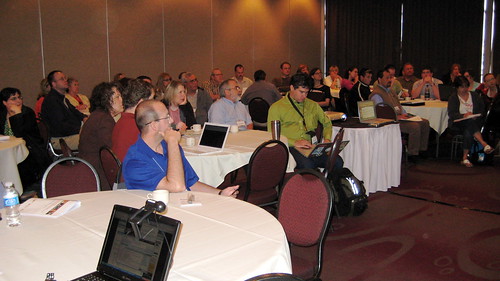
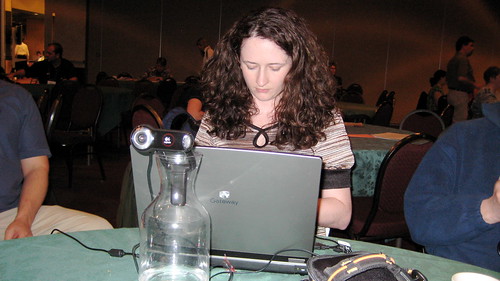
Imagine a classroom, where at any point in time, the students can interact with one another about the material being presented (or where they can engage in discussion on more important topics!). A place where 'speaking during the lesson' is not only allowed, but encouraged... This is the essence of the Ustream.tv classroom for remote participants at TLt Summit 2008 currently taking place in Saskatoon, Saskatchewan.

Although I've been a virtual attendee at a handful of distant conference experiences this year, the TLt event has been at least as memorable as Educon 2.0. In parachuting in, I'm coming to value the back-channel discussions at least as much as the presentations. Even though the parallel discussions are disorganized and random, it is easy to see how a conference could take advantage of this technology, engaging both on site participants, and remote educators.

Part of the attraction for me is that this event has attracted the attention of many from the Twittersphere, including a number of well-known Canadian edu-bloggers, and I find myself wondering what might happen if facilitators or co-hosts were to become more actively involved in prodding online participants to consider key questions/issues.

Earlier this year, I shared the story on SlideCasting 2.0 that has the potential to extend discussions and deep thinking beyond the timeframes of a given lecture; This week I've learned that even 'off-topic' discussions can be very enriching for participants!


Sample Back-Channel Chat from Stephen Downes presentation.
The Teacher 2.0 Podcast episode on this topic is now available.
Photo Credits: "Jen sets up the UStream" and "Audience" by Dean Shareski

Back-Channel Learning at TLt


Imagine a classroom, where at any point in time, the students can interact with one another about the material being presented (or where they can engage in discussion on more important topics!). A place where 'speaking during the lesson' is not only allowed, but encouraged... This is the essence of the Ustream.tv classroom for remote participants at TLt Summit 2008 currently taking place in Saskatoon, Saskatchewan.

Although I've been a virtual attendee at a handful of distant conference experiences this year, the TLt event has been at least as memorable as Educon 2.0. In parachuting in, I'm coming to value the back-channel discussions at least as much as the presentations. Even though the parallel discussions are disorganized and random, it is easy to see how a conference could take advantage of this technology, engaging both on site participants, and remote educators.

Part of the attraction for me is that this event has attracted the attention of many from the Twittersphere, including a number of well-known Canadian edu-bloggers, and I find myself wondering what might happen if facilitators or co-hosts were to become more actively involved in prodding online participants to consider key questions/issues.

Earlier this year, I shared the story on SlideCasting 2.0 that has the potential to extend discussions and deep thinking beyond the timeframes of a given lecture; This week I've learned that even 'off-topic' discussions can be very enriching for participants!


Sample Back-Channel Chat from Stephen Downes presentation.
The Teacher 2.0 Podcast episode on this topic is now available.
Photo Credits: "Jen sets up the UStream" and "Audience" by Dean Shareski